A market that no longer spikes, but won’t soften
After an extraordinary quarter in which almost every substrate used to make laminated composite pouches posted double-digit — and in some cases triple-digit — gains, flexible packaging buyers are entering the fourth quarter of 2026 facing a market that is neither as hot as spring nor as soft as many hoped.
Q2 2026: the sharpest substrate rally on record
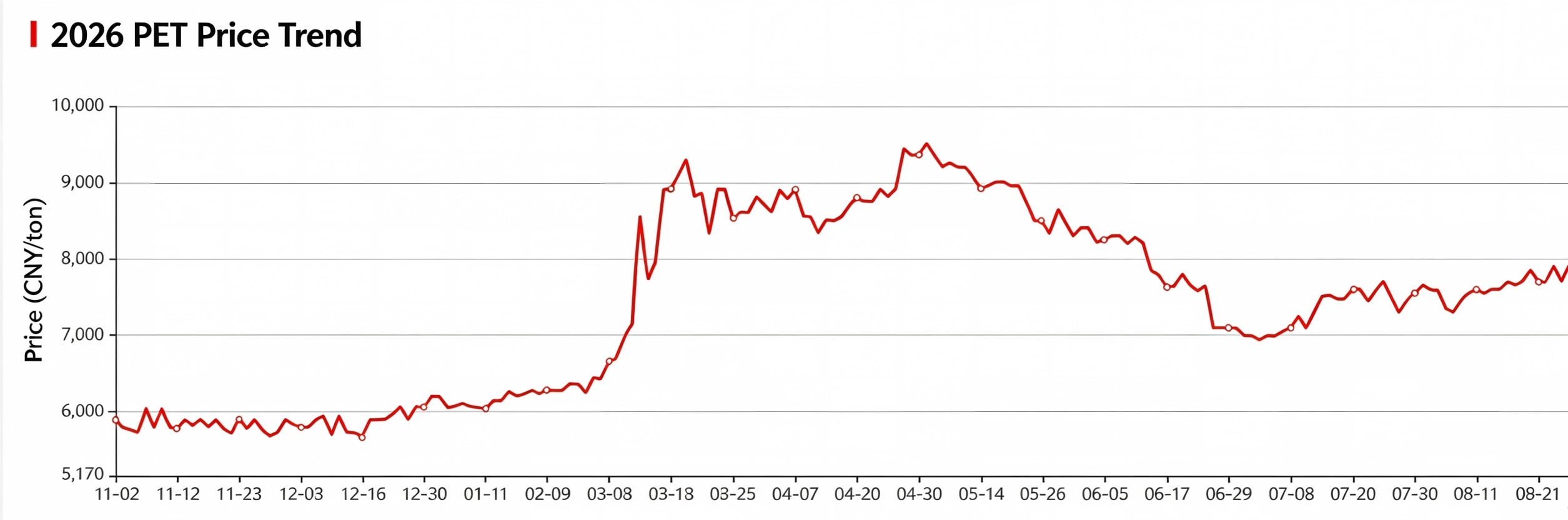
According to the Raw Material Price Index published by Flexible Packaging Europe (FPE), quarterly minimum prices in the second quarter of 2026 rose across the board. BOPP film (20 micron) nearly doubled, surging roughly 97 percent quarter-on-quarter. PET film (12 micron) climbed about 40 percent. BOPA nylon film (15 micron) rose 21 percent. Aluminium foil (7 micron) became around 12 percent more expensive, while HDPE jumped about 38 percent and LDPE about 31 percent.
Geopolitics, not demand, drove the surge
The drivers were not ordinary market cycles. Analysts at Wood Mackenzie and OPIS, cited by FPE, trace the spike to the Iran crisis and associated supply fears: extremely tight European PP resin inventories, concerns over PTA and MEG shortages feeding BOPET costs, rising PA6, PA66 and caprolactam prices lifting nylon film, and higher LME aluminium prices combined with swollen warehouse premiums for foil. Crude and energy costs compounded every layer of the laminate.
European spot prices unwind from June
By late May and June, the atmosphere began to change. European polyethylene spot prices eased as buyers shifted from securing material to negotiating affordability, and increasingly competitive offers from China strengthened the buyer’s hand. The prospect of a renewed peace agreement and the reopening of the Strait of Hormuz weighed on crude and feedstock prices; FPE’s Guido Aufdemkamp called the volume outlook “cautiously optimistic,” while flagging food-inflation risk to private consumption.
Asia, however, has not followed the unwind
On the ground in Asia, where most of the world’s composite pouches are converted, the picture through October has stayed firm. Chinese BOPET weekly reviews since July read like a drumbeat: “cost support, prices follow higher,” “supply-side contraction lifts the price center,” “post-National Day uptrend,” and in the week of October 23–29, “cost-driven gains push BOPET higher again.” NBS data from mid-August already showed LLDPE film-grade resin at about 8,602 yuan per ton, up 2.2 percent within a fortnight. The European unwind has not fully crossed into Asian film roll prices.
On the floor: converters are in no rush to cut
“What we hear from film mills in Shandong and Zhejiang is that they rebuilt margins through the summer surge and are not in a hurry to cut quotes,” said a sourcing manager at a Guangzhou-based composite bag manufacturer. “Until PTA and BOPET actually roll over on the weekly reports, pouch prices are sticky on the way down.”
Why pouch prices are sticky on the way down
Raw film typically accounts for 60 to 70 percent of the finished cost of a laminated pouch; adhesive, ink, lamination, slitting, bag-making and waste fill the rest. When resin moves sharply, converters can only pass through a portion immediately, which is why list prices historically lag film moves by two to four weeks on the way up — and lag again, more slowly, on the way down. Buyers who delayed orders in June expecting July relief are, in many cases, now paying more than they would have in May.
Four moves for buyers in Q4
Industry guidance points to four practical steps. First, shorten quote validity and lock firm-price windows rather than accepting open estimates, because spot film can move two to five percent in a week. Second, ask suppliers for index-based adjustment formulas tied to published BOPET, BOPA or LLDPE weekly assessments. Third, optimize structures: down-gauging 12 to 10 micron PET where tolerances allow, replacing foil with metallized PET (VMPET) where a total barrier is unnecessary, and moving toward recyclable mono-PE constructions.
Bag types feel different pressures
The squeeze is not felt evenly. Plain three-side-seal and zipper stand-up bags on PET/PE or PET/VMPET/PE track BOPET and PE most directly. Vacuum and frozen pouches on PA/PE feel the PA6, caprolactam and BOPA side, which has stayed firm even where PE has softened. Retort and high-barrier foil bags are additionally exposed to LME aluminium, which — after its second-quarter jump — has stayed elevated on warehouse premiums.
The rational buying posture
For now, the rational posture for buyers of three-side-seal bags, stand-up pouches, spouted pouches and retort bags is neither panic-buying nor waiting. It is disciplined contracting: order only what the next production cycle requires, price-hedge on fixed windows, and use the next quote cycle to renegotiate structure, not just price.
Post time: Oct-30-2026