Every pouch fights a different enemy
Walk through any supermarket aisle and you are surrounded by laminated composite bags: the glossy chip bag, the zippered pouch of nuts, the foil coffee block-bottom, the soft retort packet of ready-to-eat curry, the stand-up sauce pouch with a plastic spout. Each looks different because it has to fight a different enemy — oxygen, moisture, light, grease, freezer cold, or the 121-degree heat of a retort sterilizer. Choosing the wrong structure does not just look cheap; it shortens shelf life, spoils aroma, and destroys the product.
Market backdrop
Stand-up pouches already account for about 57 percent of retort-pouch format demand. Behind that growth sit two shifts: thinner, higher-performance barrier films that hold shelf life at lower grammage, and a move toward recyclable mono-material and aluminum-free structures, with mono-PE pouch launches up more than a third year-over-year.
Know what each layer does
In a typical laminate, PET provides the printable outer surface and strength; BOPP gives a crisp, glossy, low-cost print layer; metallized PET (VMPET) adds a thin foil-style barrier at lower cost; aluminium foil (AL) delivers a near-total barrier to oxygen, moisture and light; nylon (PA/BOPA) brings low-temperature toughness and puncture resistance; PE is the heat-sealing layer that touches the product; and EVOH is a specialty high-oxygen-barrier resin in multi-layer co-extrusions.
Now match the food
With that vocabulary, the food-by-food recommendations become straightforward.
Snacks & crisps: BOPP/CPP or metallized PET
Snacks, potato chips and extruded crisps are aroma- and crunch-sensitive. The classic choice is a BOPP/CPP or PET/VMPET/PE pillow or gusseted bag, often nitrogen-flushed. The metallized layer blocks light and oxygen while keeping the bag light and crunchy-crinkle — the sound itself signals freshness.
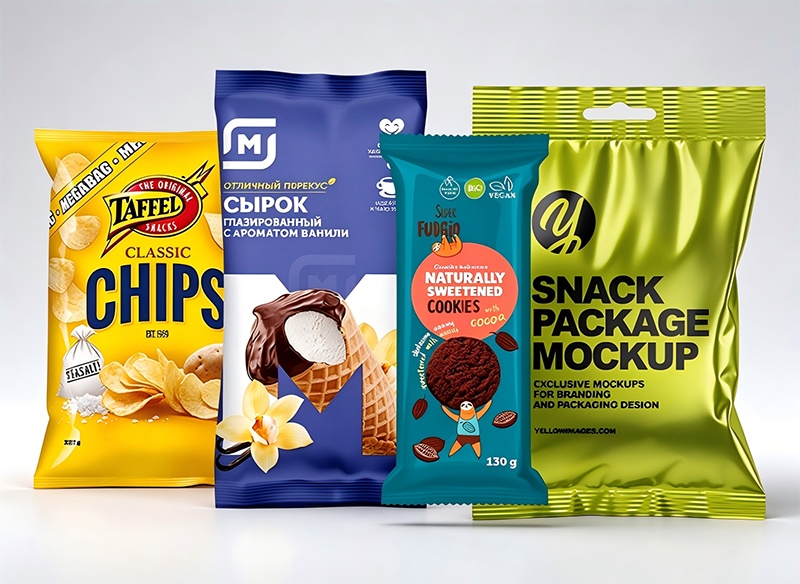
Nuts, dried fruit & coffee: metallized or foil barrier
Nuts, seeds and dried fruit turn rancid quickly under oxygen. A stand-up zipper pouch in PET/VMPET/PE is the everyday retail choice; for long-shelf-life nuts and whole-bean coffee, brands step up to PET/AL/PE, and coffee adds a one-way degassing valve and a block-bottom gusset that stands steadily on the shelf. Tea similarly goes into PET/VMPET/PE three-side-seal sachets or foil-lined bags.
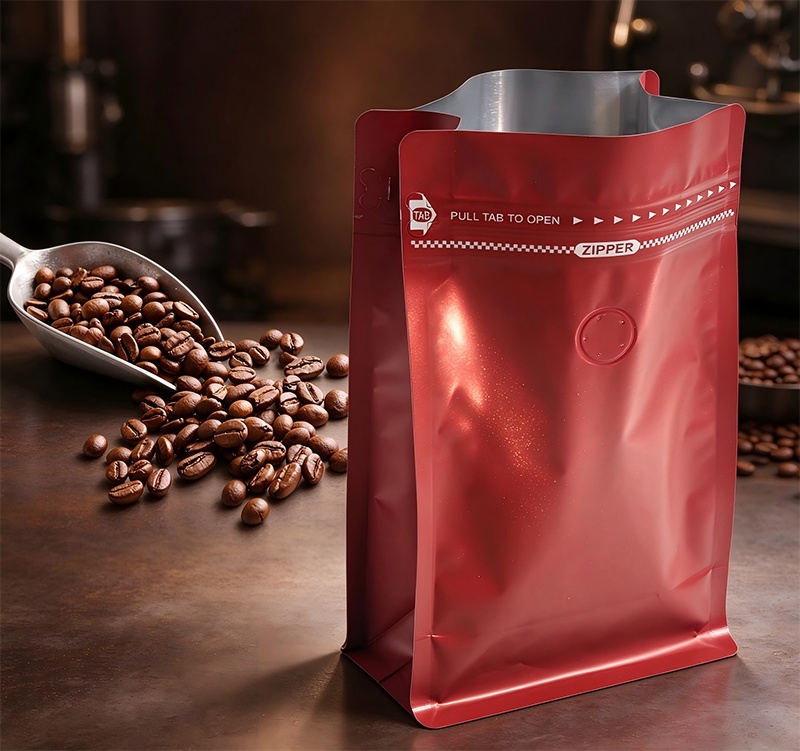
Frozen meat & seafood: PA/PE vacuum
Frozen meat, seafood and ready meals need a film that stays flexible and puncture-resistant at -18 °C. That is why the industry standard is a PA/PE nylon vacuum pouch, sometimes embossed to pull a tight vacuum around irregular products. For wet pet food and marinated meats where shelf stability matters more than freezing, PET/AL/PE stands up to grease and oxidation.
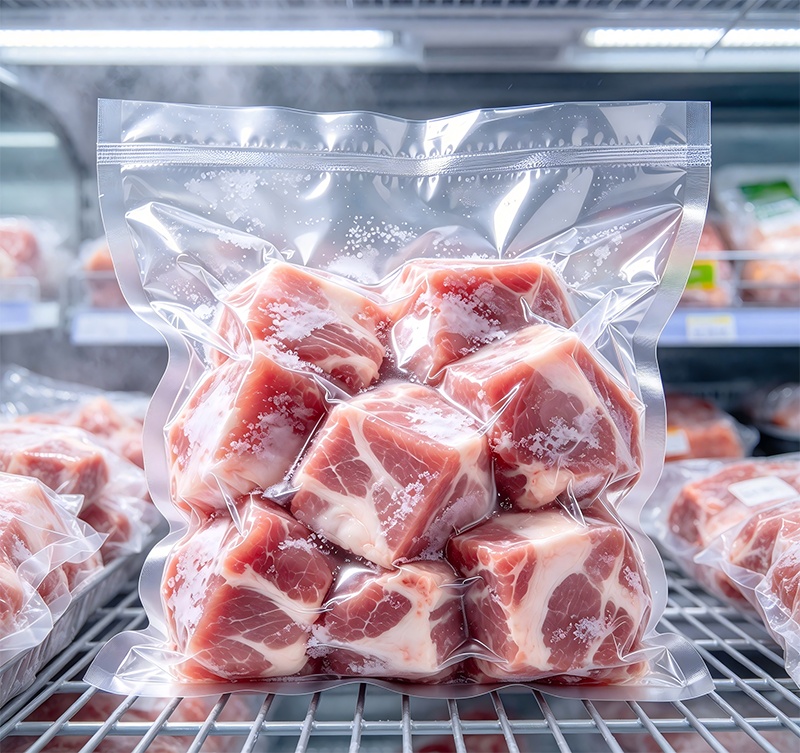
Retort ready meals: foil or transparent retort
Ready meals, pouch curries and soups must survive pressurized steam sterilization at roughly 121–130 °C. The workhorse structure is PET/AL/RCPP (cast polypropylene sealant), with transparent retort bags in PET/PA/RCPP increasingly popular when brands want consumers to see the product through the film. These pouches keep food shelf-stable for one to three years without refrigeration.
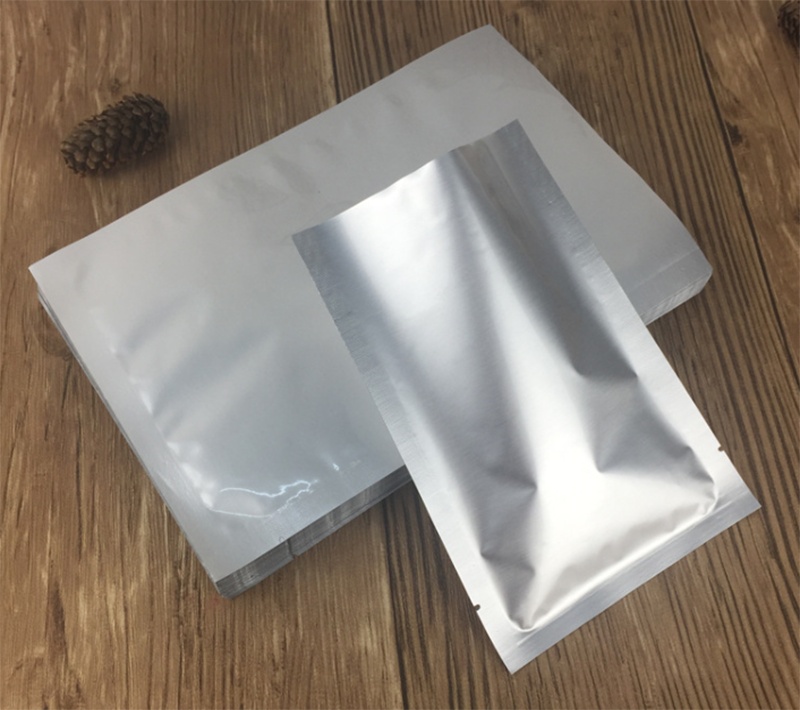
Sauces & liquids: spouted stand-up pouch
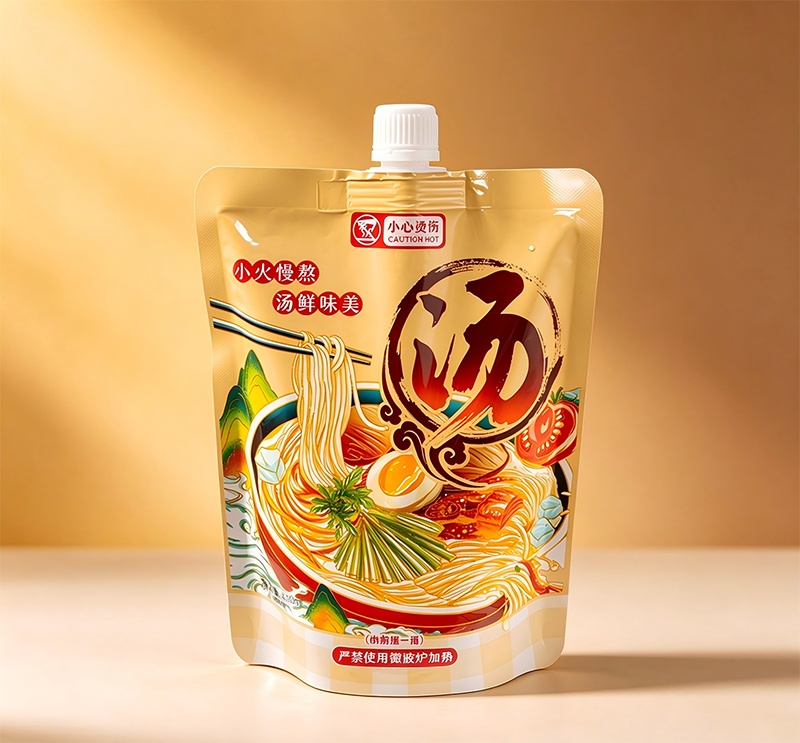
Sauces, ketchup, jams, edible oils and beverages that consumers squeeze or pour are almost always filled into spouted stand-up pouches — a doypack in PET/AL/PE or PET/VMPET/PE with a screw-cap fitment heat-sealed into the corner. The same format suits baby food, single-serve coffee drinks and liquid detergents.
Powders, spices & small sachets
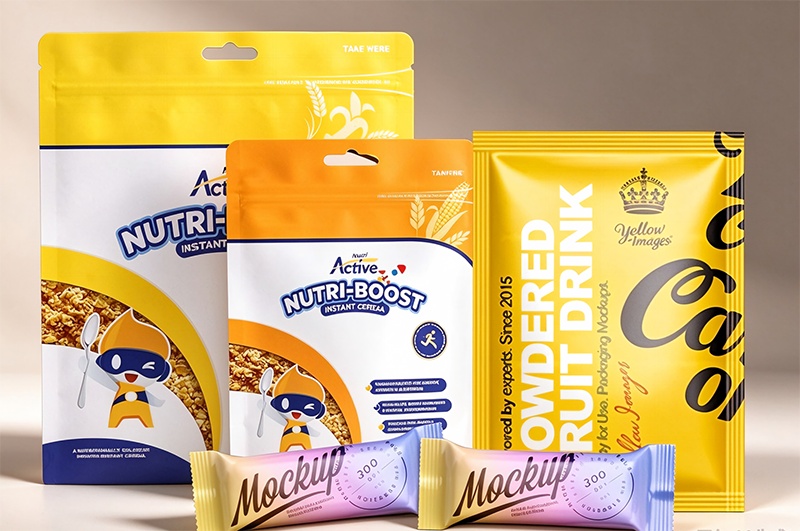
Powders, spices, seasonings and freeze-dried products commonly go into three-side-seal sachets in PET/VMPET/PE, or PET/AL/PE for premium spices. Whole-bean and ground coffee, again, upgrades to foil with a valve.
The format decision
The bag format is a second layer of choice. Three-side-seal bags suit single-serve sachets. Stand-up pouches (doypacks) win on retail shelf presence and resealable zippers. Spouted pouches are the practical choice for liquids. Vacuum pouches are reserved for meats, cheeses and industrial use. Retort pouches are engineered for sterilization. Gusseted and block-bottom bags stand square for rice, coffee and bulk snacks. Pillow bags remain the low-cost default for flow-wrapped snacks.
Recyclability is rewriting the specs
The sustainability shift is quietly changing the math. Regulators in the EU, UK and parts of North America are increasingly requiring recyclable packaging and recycled content. Where a product does not need a full aluminium barrier, converters now offer recyclable mono-PE structures, aluminum-free high-barrier films and paper-laminated pouches — options that used to carry a premium but are approaching price parity as volumes scale.
The buyer’s rule of thumb
Define the required shelf life, the fill temperature, the storage conditions (frozen, ambient, hot-filled), and the barrier each demands — then choose the simplest structure that meets them. Over-specifying foil where metallized film would do wastes money and hurts recyclability; under-specifying barrier on a fatty nut product guarantees returns. The best composite bag is the one matched exactly to the food inside it.
If you need composite bags, please contact us for a quotation promptly.
When making the inquiry, please provide us with the following information so that we can offer you a quote promptly:
(1) Bag type.
For example: three-sided sealed bag, middle-sealed bag, zipper self-standing bag, three-sided sealed with flap bag, flap self-standing bag, eight-sided sealed bag, special-shaped bag, rolled film, vacuum bag.
(2) Size, or capacity
Note: If self-standing is required, the bottom size is also needed.
(3) What to pack? Or what material?
If you are not sure about the material, please let us know. Tell us what the bag is used for, and we will recommend suitable materials and thicknesses for you.
(4) How many bags do you need?
The price varies with the quantity. The more the quantity, the more cost-effective the price will be. But don’t worry, we can also make small quantities of bags. Because we can provide plate printing and digital printing. The minimum order quantity for plate printing is usually 20,000 bags. And the minimum order quantity for digital printing is usually 5,000 bags.
Post time: Oct-30-2026